

The Pact Resource Hub serves as a repository for sharing documents, best practices, and resources to assist signatories in implementing the Responsible Buildings Pact. Should you have any questions about the resources provided below, please contact the Climate Smart Buildings Alliance.
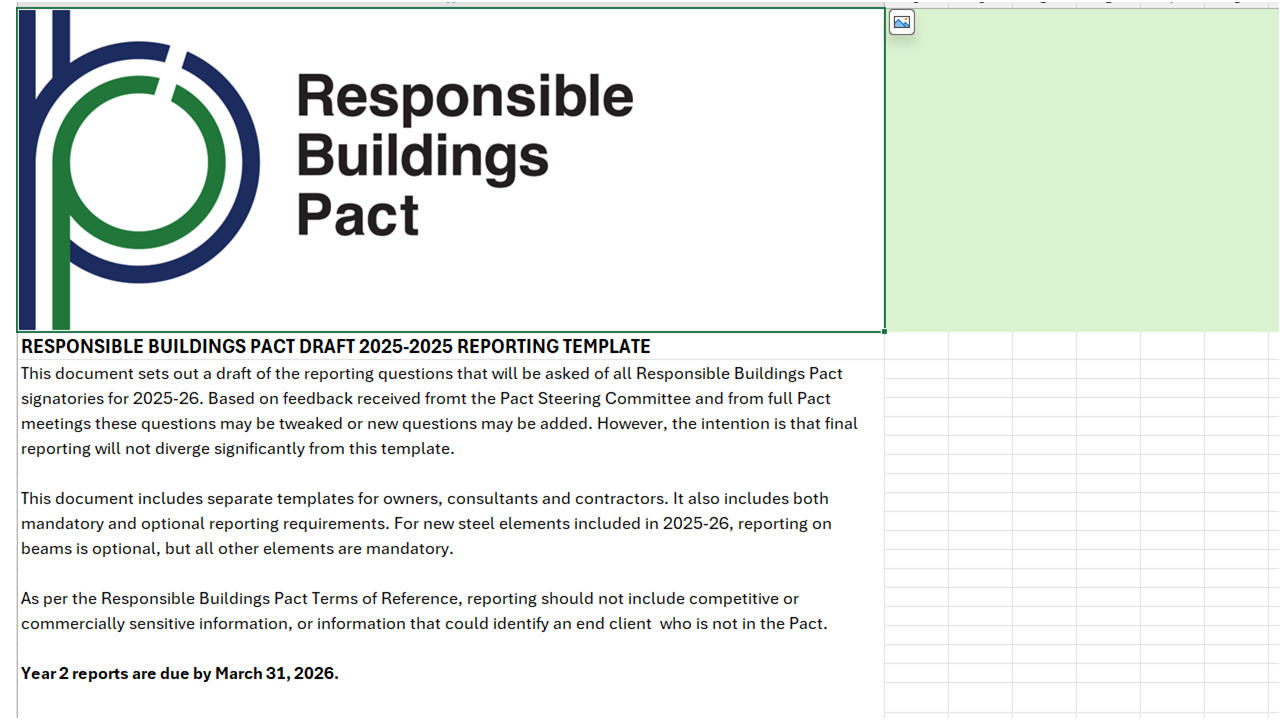
2026-27 Draft Reporting Template
This excel document outlines the exact information Pact signatories will be asked to submit by March 31, 2026. The final template will be approved in our November 2026 full Pact meeting.
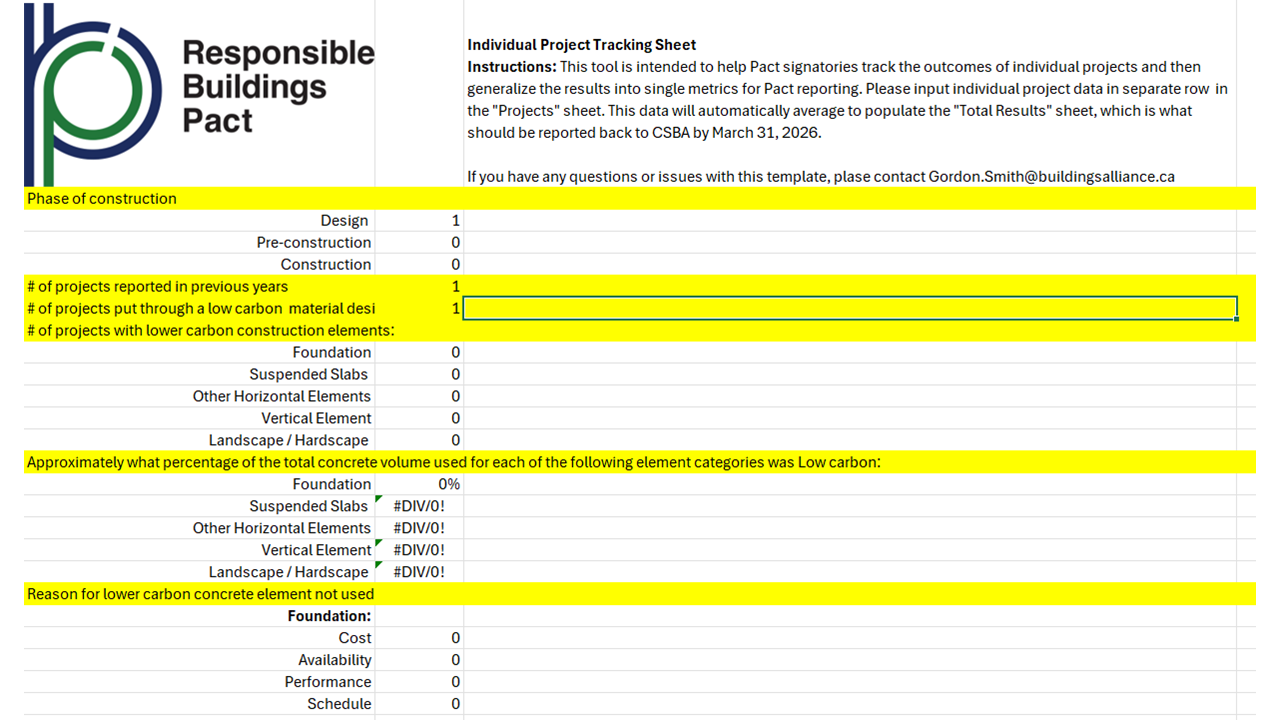
Individual Project Tracking Tool
This is a tool to help Pact signatories track the results for individual projects and then average the results across all projects for easy annual Pact reporting - based on the draft 2026-27 Pact reporting template.
Use of this tool is optional - but hopefully helpful. CSBA is only interested in receiveing averaged information across all projects, not the specific data from any individual projects.
Low-Carbon Concrete Procurement Guide
Concrete is one of the most widely used building materials in Canada and plays a critical role in both housing and infrastructure. As demand for lower-carbon buildings grows, project teams need practical guidance on how to specify and procure concrete that reduces embodied carbon while meeting performance, durability, and cost requirements.
The Low-Carbon Concrete Procurement Guide builds on the research and stakeholder engagement completed through CAGBC’s Burying Carbon in Buildings initiative funded by Environment and Climate Change Canada. It provides practical guidance to help project owners, designers, developers, contractors, and procurement professionals confidently specify and procure lower-carbon concrete, including concrete produced using carbon capture and utilization in cementitious building materials (CCU-CBM) technologies.

Guidebook: Concrete a Pragmatic Approach to Embodied Carbon (2023)
Concrete: A Pragmatic Approach to Lowering Embodied Carbon is an easy-to-use interactive guide that provides cost effective and efficient strategies for reducing embodied carbon of concrete in the built environment. Co-authored by ZGF Architects, Fast+Epp, EllisDon, and Lafarge, the technical guide has been developed for owners, architects, engineers, contractors, concrete suppliers, and other stakeholders in the Lower Mainland of British Columbia, Canada.
The guide outlines steps for project teams at every phase of the design process, including many cost-effective strategies to reduce the global warming impact of concrete. These clear and actionable steps are intended to aid project teams in reducing the embodied carbon of any project utilizing concrete. Note, these are regionally specific to the Lower Mainland of BC and may differ for other markets.
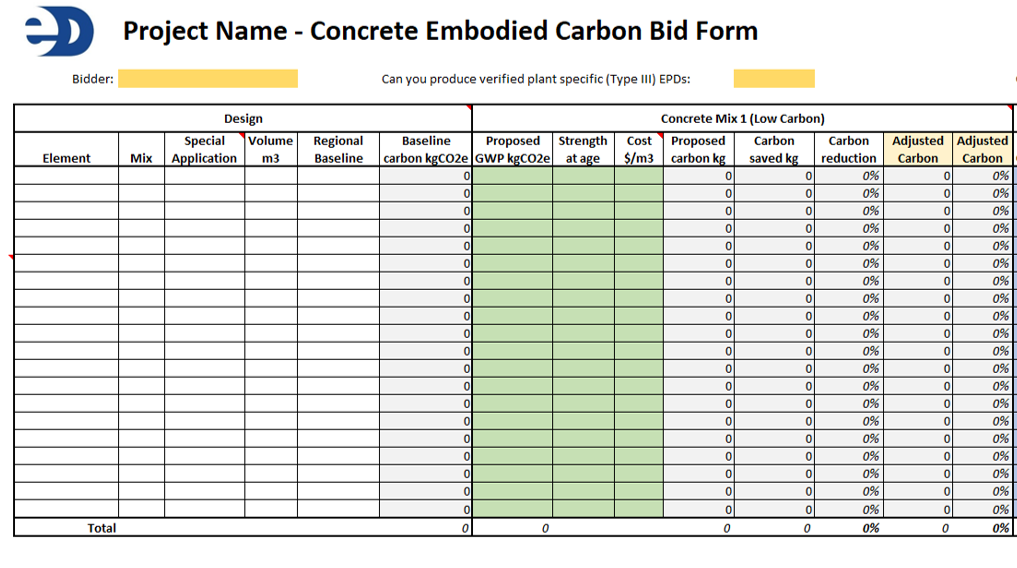
Concrete Embodied Carbon Bid Form Template
Developed by the Sustainable Building Solutions Team at EllisDon, these single-bid and multiple-bid forms provide a template companies can use to orient a bid towards both cost and an emissions reduction target. EllisDon implementing this template across business units as port of a company wide strategy to reduce embodied carbon.
Multiple Responsible Buildings Pact signatories, from structural engineers to residential developers, have adapted the EllisDon template for their own business applications, some seeing a 20%+ reducution in embodied carbon with a marginal cost difference.
The template is being shared to encourage more companies to take it and adapt it to reduce concrete emissions in their tendering processes.
2025-26 Draft Reporting Template
This excel document outlines the exact information Pact signatories will be asked to submit by March 31, 2026. The final template will be approved in our November 2025 full Pact meeting.
Individual Project Tracking Tool
This is a tool to help Pact signatories track the results for individual projects and then average the results across all projects for easy annual Pact reporting - based on the draft 2025-26 Pact reporting template.
Use of this tool is optional - but hopefully helpful. CSBA is only interested in receiveing averaged information across all projects, not the specific data from any individual projects.
NRC - National Tiered GHG Emission Limits for Steel Construction Products
This document from Canada's National Research Council establishes rankings of commonly used categories of structuraland reinforcement steel products, as well as relevant semi-finished precursors, based on the GHG emissions associated with their production. It was developed to support the Federal Government's Standard on Embodied Carbon in Construction.
The Pact is using this resource for reporting on low carbon steel which we define as anything better than "the best 50% EC Limit" as detailed in the table on page 4.
By aligning with the federal government we hope this will support a common national approach that works for public and private sectors.

The Upfront Carbon Façade Materials Guide - SvN
The Upfront Carbon Façade Materials Guide was developed by SvN as a practical tool for design teams working on larger-scale buildings in Ontario, helping to foreground upfront carbon emissions as a key criterion in façade material selection. Through side-by-side comparisons and strategic insights, this guide empowers designers to make more responsible choices.